
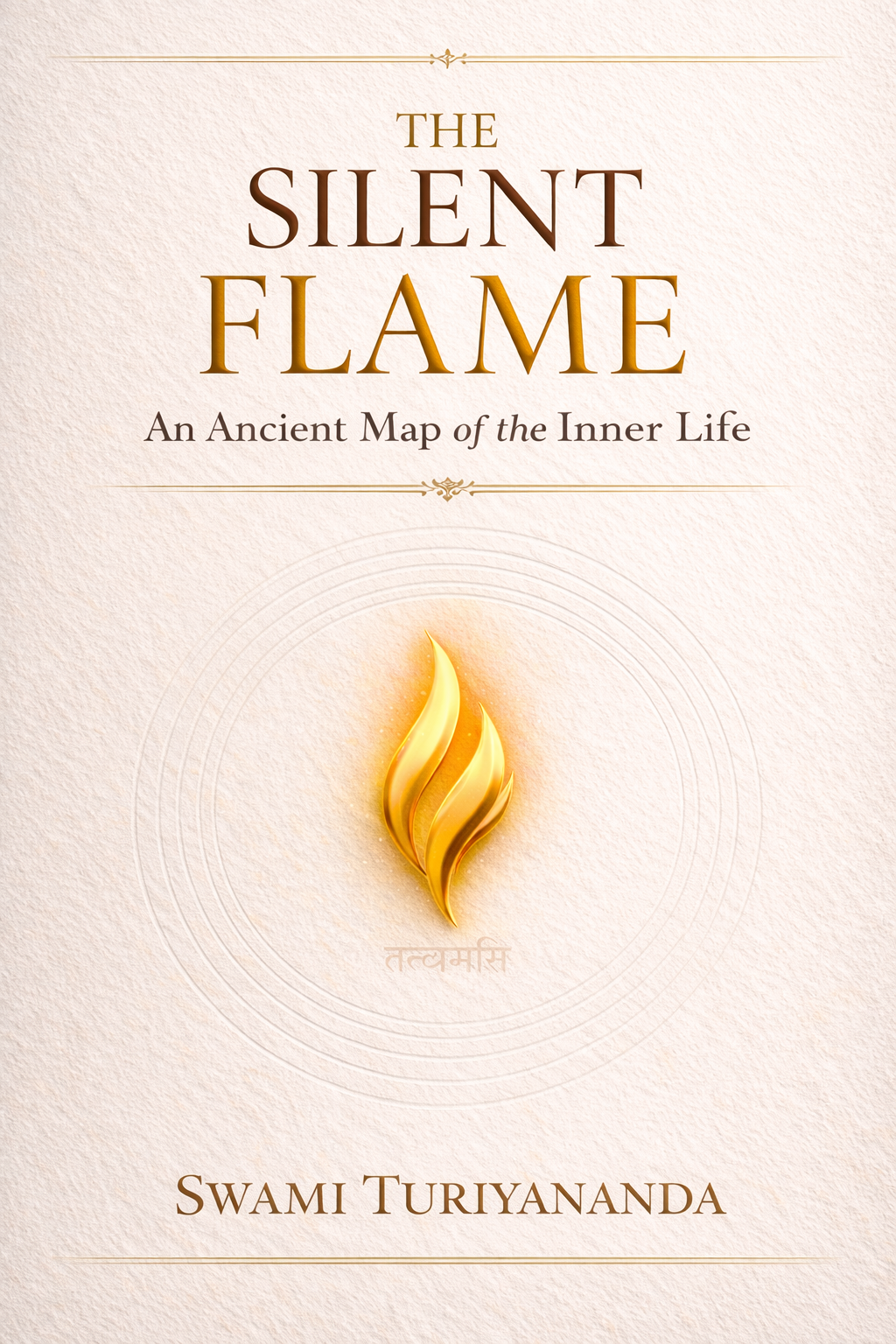
An Ancient Map of the Inner Life
The person this book is written for is not in crisis. They are accomplished — professionally capable, reliably present, often responsible for others. From the outside, their life looks complete. Inwardly, something remains unresolved. Not brokenness. A quiet fragmentation.
Three thousand years ago, the seers of the Taittiriya Upanishad looked carefully at the human being and described what they found: five living layers of experience, from the physical body to the quiet awareness that underlies all of it. They called their map the Panchakosha. They did not offer it as belief. They offered it as observation.
The Silent Flame restores that map — and crosses it with the four classical yoga pathways to create a complete system of inner restoration that allows each reader to understand not only where they are dispersed, but which path home is native to their own nature.
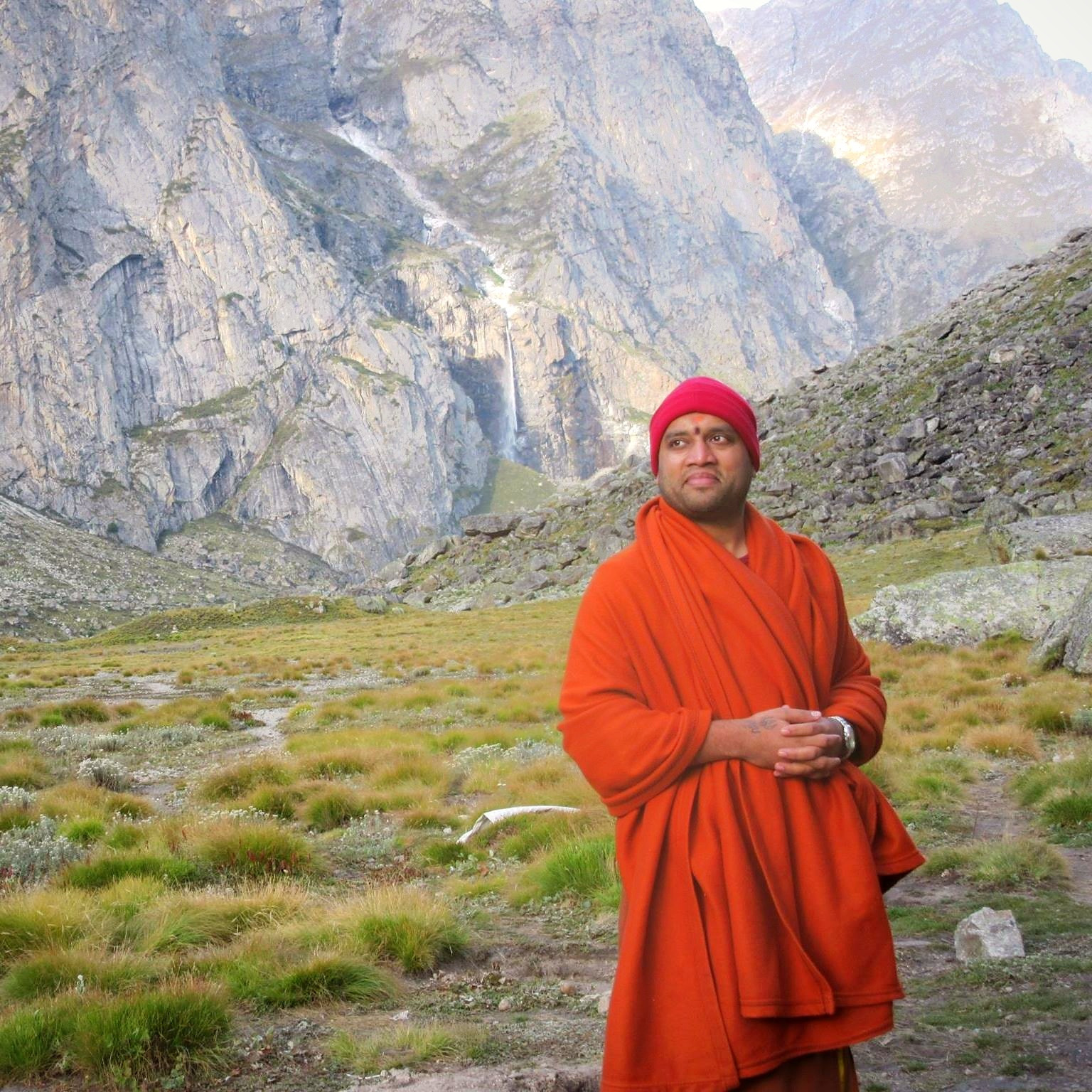
A voice at home in both worlds.
Swami Turiyananda has walked the investment banking floors of London and Singapore, and lived in silent Himalayan caves. He is not a Western person who discovered Eastern wisdom, nor an Eastern teacher translating himself for Western audiences. Both the worlds are genuinely native to him. That lived biography is the source of this book's unusual authority.
I did not write this book from theory.
I wrote it from the life that produced the theory.
That distinction — between broken and dispersed — is where this book begins, and where three thousand years of Vedantic inquiry turns out to be more useful than anything the modern self-development tradition has yet produced. Not diagnosis. Not repair. A restoration of what was always present.
Most books in this space do one thing: they diagnose, or they prescribe. The Silent Flame does both — with a precision that does not exist in published form elsewhere. The Panchakosha reveals where fragmentation has occurred. The four yoga pathways show the way back. The crossing of the two makes the system personal.
Each reader’s dominant nature — intellectual, devotional, action-driven, or introspective — points to one of the four yoga pathways as genuinely native to them. The prescription is not universal. It is personal. The reader does not choose their pathway through analysis. They recognise it.
Within the chosen pathway, the Panchakosha diagnosis reveals precisely where the work begins. Two readers of identical temperament may enter at entirely different layers — because their dispersal has concentrated differently. Same pathway. Different entry point. Completely different initial practice.
The body as instrument. The ground through which all experience is received and all action expressed.
The field of breath, vitality, and internal regulation. The most commonly depleted layer in high-functioning professionals.
The landscape of thought, emotion, and reactive pattern. Restless by nature — requiring not suppression but understanding.
The faculty of discernment. When clear, decision-making becomes steady. When clouded, capability alone cannot produce good outcomes.
The quiet ground of inner continuity. Not a state to be achieved. A recognition to be uncovered.
The path of discernment and direct understanding. Truth approached through sustained, honest inquiry into the nature of experience itself.
The path of surrender and love. The inner life approached through the dissolution of self-contraction into something larger than the personal.
The path of consecrated action. Work as inner practice — the gradual release of identification with outcome through sustained, conscious engagement.
The path of meditative practice and inner mastery. The systematic training of attention toward its own source.
This mapping — Panchakosha crossed with the four yoga pathways — is the author’s original contribution to the literature of inner development. Developed over a decade of 1-on-1 mentorship work with students from more than forty countries, it does not appear in published form elsewhere. The Panchakosha and the yoga pathways have coexisted in the Vedantic tradition for three thousand years; what did not exist was a person who had been shaped by both the tradition's deepest silence and the professional world's specific dispersal; someone who had needed this map himself before he could draw it. The book makes this system available to any reader, anywhere, without prior knowledge or a teacher in the room.
I did not begin with philosophy.
I began with a question that arrived without invitation, somewhere over the Arabian Sea, at an altitude of thirty-five thousand feet, in the middle of a life that was producing exactly what it had been designed to produce.
The career was going well. The decisions I was being asked to make were consequential. By the measures I had been taught to respect, there was nothing to question.
And yet the question came.
Not loudly. Not with the drama of a crisis. It arrived the way the most important things tend to arrive, quietly, in a moment when the outer noise had briefly paused, and something underneath became audible for the first time.
What is all of this leading toward?
I did not ask it as dissatisfaction. I had not failed at the life I had been building. I asked it as a person who had followed a plan carefully and arrived at something that felt, in its own way, slightly beside the point. Success was present. Deeper contentment was not.
That question did not leave.
Over the years that followed, years of sustained silence, of study in the Himalayan tradition, of working with others carrying their own versions of the same question, I came to understand something the ancient seers of India had understood long before modern civilisation began assembling its external sophistication.
The human being is not broken. The human being is dispersed.
What is never given time does not disappear. It simply waits.
This book does not introduce a new philosophy. It restores recognition of something ancient, precise, and already present in the structure of your own experience.
The Taittiriya Upanishad, one of the oldest contemplative texts in the human record, describes the human being not as a single point of experience but as a layered architecture of five distinct dimensions. The physical body. The field of breath and vitality. The mind and its landscape of thought and feeling. The faculty of discernment and judgement. And at the innermost layer, a ground of quiet continuity that has never been disturbed by anything the outer life has brought.
The ancient seers called this structure the Panchakosha. They did not present it as theology. They presented it as direct observation, a map drawn from thousands of hours of sustained inquiry into the nature of human experience. They preserved it not because it was philosophically elegant, but because it was practically true: when these layers function in alignment, the human being experiences clarity, steadiness, and inner coherence. When they fall into fragmentation, as modern life, with its relentless outward pull, so effectively produces, something essential is lost, regardless of what has been accumulated.
This map was not drawn for monks. It was drawn for the human being, for anyone living in the midst of the world's full complexity, carrying responsibility, navigating difficulty, seeking a quality of inner life that does not depend on external circumstances being arranged in precisely the right way.
In three thousand years, that person has not changed. Only the complexity of the world they navigate has.
You are not required to adopt any belief to read what follows. You are not required to agree with anything in advance. The only requirement is what the ancient seers themselves insisted upon: not faith, but attention. The willingness to look carefully at what is actually present in your own experience, without the distraction of what should be present.
You have already felt its edges, in the question that arises late at night when the outer noise falls back. In the sense that something within has not yet been fully inhabited. In the moments of unexpected stillness that appear, briefly, before the day reclaims its momentum.
Something steady. Something that has never been hurried. Something that has never been exhausted.
You have not imagined it. It is there. It has always been there. What was missing was not the thing itself but a language precise enough to name it, and a map clear enough to show the way.
This book is that map. Not as instruction. As recognition.
There is a certain kind of tiredness that people carry today which does not always come from the body
It is not the tiredness of physical exertion, the clean fatigue of a day spent in motion. It is something more layered than that. A quality of weariness that persists through rest, that is present in the morning before the day has made any demands, that sits quietly beneath the surface of a life that, by every external measure, appears to be functioning well.
The person carrying it wakes early. Fulfils their obligations with care. Is reliable to the people around them. Makes considered decisions and carries them through. From the outside, and often from their own assessment, there is little to point to as wrong.
And yet.
There is a quality of inner life that such a person rarely speaks of, and that the world around them rarely asks about. A sense that the mind is always moving from task to task, concern to concern, decision to next decision; without ever fully arriving.
The ancient seers did not invent the structure of what follows. They mapped it. In the Taittiriya Upanishad, the human being is described not as a single identity but as a layered architecture of five living dimensions. This map, the Panchakosha, reveals how fragmentation occurs, and how it can be restored.
It is not offered here as philosophy to be studied. It is offered as a map of what you already are: one that, once seen clearly, is not easily unseen.
The book asks nothing of the reader in advance — no belief, no prior knowledge, no renunciation of the life already built. Only the quality of attention the tradition itself always insisted upon: the willingness to look carefully at what is actually present in one’s own experience.
A precise, undramatic examination of how modern professional life quietly disperses the inner layers of a person who is, by every visible measure, functioning well. Not diagnosis. Recognition. The reader does not change anything. They see clearly — perhaps for the first time.
The Panchakosha introduced as a living map, not a historical artefact. Each of the five layers explored as something the reader has already encountered in their own experience — without having had a language for it. The map of what they already are.
The four yoga pathways mapped onto the Panchakosha layers. Temperament reveals the path. Kosha diagnosis reveals the entry point. The reader does not calculate this. They recognise it — and begin where they actually are, not where they think they should be.
“ A mind that is never allowed to settle slowly forgets what stillness feels like. ”
“Success was present. Understanding was not. ”
“ When the layers move in different directions, life feels heavy. When they begin to move together, life feels whole.”
“ The silent flame was never absent. It was only obscured. ”
These are not passive followers acquired through algorithms. They are people who sought this teaching out, travelled for it, and have been changed by it.
Active learners across the Panchakosha Sadhana, mentorship, and retreat programmes
USA, UK, Europe, Russia, Iran, India, Southeast Asia, and across the global diaspora
An established platform with depth of relationship, not recency of discovery
The reader this book is written for already exists within this community — and extends far beyond it. They are the professional aged 35–60 who has built something real and senses that external mastery alone will not take them the rest of the way. They are already purchasing Eckhart Tolle, Michael Singer, Viktor Frankl, and Ryan Holiday. The Silent Flame is the book they have been waiting for without knowing what to call it.
For those who wish to continue the work — the ashram, the teacher, and the Himalayas are there.
A structured 21-minute daily practice that works directly with the five layers. The reader who has understood the map can begin walking it.
The personalised Panchakosha–yoga pathway system in direct, sustained practice with the author. The living core of what the book introduces.
The ashram at Badrinath. Silence. The Ganga. The mountains. For those who want to go all the way.
The book reaches millions. The ashram is there for those who want to go deeper. This is not a book with a course attached. It is the opening of a complete inner development lineage with a living teacher, a physical place, and a tradition older than the questions it answers.
“A living bridge between the worldly and the spiritual. His rare blend of finance-world experience and deep spiritual practice offers a grounded, practical approach to living a genuine inner life in today’s world.”
“Meeting Swamiji began a profound transformation in my spiritual understanding. His guidance opened a doorway to profound stillness and insight, forever changing my perspective on life.”
For publishers, literary agents & rights enquiries
the full manuscript, proposal, and supporting materials
are available immediately upon request.
Write directly. Materials follow within 24 hours.
No newsletters. No other correspondence.
Only the announcement that the book is available.
Your details will not be shared or used for any other purpose.
The flame has noted your name.
You will hear when it speaks.